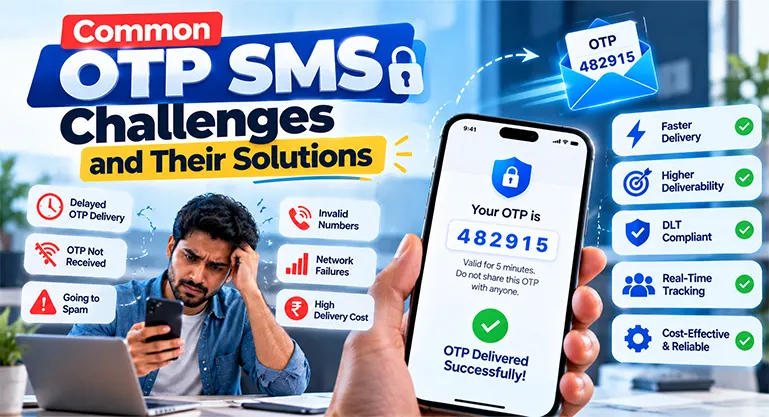
OTP SMS plays an important role in protecting online accounts, verifying user identities and securing digital transactions. Banks, e-commerce platforms, educational institutions and business applications use One-Time Passwords (OTPs) to confirm that a user has access to a registered mobile number.
However, OTP delivery does not always happen as expected. Delayed messages, failed deliveries, incorrect OTP entries, network congestion and security threats can interrupt the verification process and frustrate users.
For businesses that depend on mobile verification, understanding these problems is essential. Text SMS helps businesses explore reliable messaging practices for OTP SMS delivery, API integration and transactional communication.
What Is OTP SMS and Why Is It Important?
OTP SMS is a text message containing a temporary verification code sent to a user's mobile number. The code is used to confirm an action, such as logging in, creating an account, resetting a password, or authorising a transaction.
Unlike a permanent password, an OTP is designed for limited use and validity. Its effectiveness depends on secure implementation, timely delivery and proper verification controls.
Businesses commonly use OTP SMS for:
- User registration and mobile number verification.
- Login authentication and account recovery.
- Password resets and profile changes.
- Transaction confirmation and payment verification.
- Delivery confirmation and customer account access.
A dependable OTP system helps reduce unauthorised access while providing a convenient verification experience.
Common OTP SMS Challenges and Their Solutions
1. Delayed OTP SMS Delivery
The challenge: Users request an OTP but receive it several seconds or minutes later. This can happen because of network congestion, routing problems, temporary operator issues, or overloaded messaging systems.
Delayed codes can expire before users receive them, causing repeated requests and failed logins.
The solution:
- Choose an SMS provider with reliable routing and delivery monitoring.
- Track message submission, delivery reports and response times.
- Set an appropriate OTP validity period based on security requirements.
- Avoid sending multiple OTPs unnecessarily.
- Provide a clear option to request a new code after a reasonable wait.
Text SMS integration with a suitable messaging infrastructure can help businesses monitor delivery performance and investigate recurring delays.
2. OTP SMS Not Being Delivered
The challenge: An OTP may fail to reach the recipient because of an incorrect mobile number, an inactive SIM, operator filtering, routing failures, or restrictions affecting the sender or message template.
This problem can prevent users from completing registration, logging in, or confirming transactions.
The solution:
- Validate mobile number formats before sending messages.
- Check sender IDs, approved templates and applicable DLT requirements in India.
- Monitor delivery reports and failure reasons where available.
- Review provider and telecom network configurations.
- Offer a secure alternative verification method when appropriate.
Businesses should investigate recurring failures instead of assuming every unsuccessful message is caused by the recipient's network.
3. Incorrect OTP Entry
The challenge: Users sometimes enter the wrong code because they mistype digits, confuse an old OTP with a new one, or switch between multiple messages.
Repeated incorrect entries can lock users out or create unnecessary support requests.
The solution:
- Display clear instructions beside the OTP input field.
- Make the code easy to enter on mobile devices.
- Support secure autofill where the platform allows it.
- Explain when a code expires and how to request another.
- Apply reasonable attempt limits to prevent guessing attacks.
The verification interface should also make it clear when a newly requested OTP invalidates an earlier code.
4. OTP Expiry Before the User Can Enter It
The challenge: A code expires before the user receives or enters it. This often happens when delivery is delayed or the validity period is too short for the expected user experience.
The solution:
- Choose an expiry period that balances usability and security.
- Display a countdown or clear expiry message.
- Allow users to request a replacement code after the permitted interval.
- Ensure server-side validation rejects expired OTPs.
- Prevent repeated requests from creating confusing verification states.
A longer validity period is not always safer. Businesses should assess delivery latency and security risks before changing expiry settings.
5. Too Many OTP Requests
The challenge: Users repeatedly request codes when the first message is delayed. Automated scripts can also generate excessive requests, increasing costs and putting pressure on messaging infrastructure.
The solution:
- Introduce a resend cooldown.
- Apply rate limits to accounts, phone numbers, devices and IP addresses where appropriate.
- Use abuse detection to identify unusual request patterns.
- Monitor message volume and cost spikes.
- Provide helpful status messages during the waiting period.
These controls help protect messaging resources while giving genuine users a reasonable path to complete verification.
6. SMS Gateway or API Integration Errors
The challenge: An OTP request may fail because an application sends an incorrectly formatted API request, uses invalid credentials, exceeds account limits, or handles provider responses incorrectly.
Poor error handling can also cause duplicate messages or leave users waiting without an explanation.
The solution:
- Follow the provider's API documentation carefully.
- Validate request parameters and authentication credentials.
- Handle timeouts, errors and retry logic correctly.
- Use unique request identifiers or idempotency controls where supported.
- Test the integration before deployment and monitor production errors.
Text SMS API integration can support automated OTP delivery when the application, gateway and messaging configuration are set up correctly.
7. OTP SMS Security Risks
The challenge: OTP SMS can be exposed to phishing, SIM-swap fraud, social engineering and other attacks. A person may trick a user into sharing a valid code, even when the messaging service itself works properly.
SMS verification also does not provide the same protection against every threat as stronger authentication methods.
The solution:
- Never ask customers to disclose OTPs to staff.
- Bind OTP verification to the intended action and account.
- Limit attempts and invalidate codes after successful use.
- Protect OTPs from exposure in application logs.
- Use stronger authentication, such as passkeys or authenticator-based methods, for higher-risk activities where appropriate.
Businesses should treat OTP SMS as one component of a wider security system.
8. Rising OTP SMS Costs
The challenge: High verification volumes, repeated requests, failed attempts and fraudulent traffic can increase messaging expenses.
The solution:
- Measure OTP requests and successful verifications.
- Reduce unnecessary resend attempts through better interface design.
- Detects automated abuse and unusual traffic.
- Compare provider pricing, coverage, support and delivery performance.
- Track cost per successful verification rather than message volume alone.
Cost optimization should never depend on removing essential security checks.
Use Cases of OTP SMS in Business
Use Case 1: E-Commerce Customer Login
An online store wants customers to log in quickly without relying only on traditional passwords. It introduces OTP SMS verification for supported login and account recovery workflows.
The store validates phone numbers, applies resend limits, monitors delivery reports and provides clear instructions when a code expires.
Expected benefit: A smoother login experience, better visibility into verification failures and fewer avoidable support requests.
Use Case 2: Banking and Digital Payment Verification
A financial service uses OTP SMS as one verification step for selected customer actions. The system connects its application to an SMS API and applies strict expiry and attempt controls.
The team monitors delivery failures and uses additional risk checks for sensitive transactions.
Expected benefit: More structured verification workflows and better monitoring of delivery issues. OTP SMS alone does not guarantee transaction security.
Case Studies: Solving OTP SMS Delivery Problems
The following case studies are illustrative business scenarios, not verified client results.
Case Study 1: An E-Commerce Platform Reduces Login Friction
Problem: Customers frequently reported that login codes arrived late or expired before they could enter them.
Approach: The company reviewed delivery reports, checked gateway response times, improved its resend instructions and introduced appropriate rate limits. It also investigated recurring delivery failures by network and time period.
Measurement: The team compared delivery latency, successful verification rates, resend frequency and login abandonment before and after the changes.
Learning: Improving OTP delivery requires attention to both messaging infrastructure and the user interface. The actual improvement must be established through measured results.
Case Study 2: A Business Application Improves API Reliability
Problem: A business application experienced inconsistent OTP delivery after changes to its verification system. Some API requests timed out, while others produced confusing error messages.
Approach: Developers reviewed API responses, improved timeout handling, added controlled retries and checked for duplicate requests. They also introduced monitoring for submission failures and verification completion.
Measurement: The team tracked API error rates, duplicate sends, successful verification attempts and support tickets.
Learning: Reliable OTP SMS depends on application logic, gateway configuration, network delivery and secure verification rules working together.
How Text SMS Supports OTP Messaging Requirements
Businesses need an SMS solution that fits their technical requirements, message volumes and security expectations. Text SMS offers messaging services relevant to business communication, including OTP SMS and SMS API capabilities.
When evaluating an OTP messaging setup, businesses should consider:
- API documentation and integration support.
- Delivery reports and troubleshooting options.
- Sender ID and DLT compliance support in India.
- Expected message volumes and pricing.
- Monitoring, reliability and technical assistance.
- Security controls within the business application.
A well-planned OTP workflow helps businesses identify failures quickly, reduce unnecessary retries and provide a clearer verification experience for customers.
FAQs About OTP SMS Challenges and Solutions
Delays may result from network congestion, operator routing, gateway issues, or temporary service interruptions. Check delivery reports and provider status to identify recurring problems.
Check the registered mobile number, wait for the recommended interval and request another code if permitted. Businesses should investigate repeated delivery failures.
The validity period depends on the security risk and application requirements. Businesses should balance timely verification with a reasonable opportunity for users to enter the code.
An SMS API can automate message requests and provide delivery information where supported. Actual delivery performance depends on the provider, routing, telecom networks and application configuration.
No. OTP SMS can be affected by phishing, SIM-swap fraud and social engineering. Sensitive applications should use additional security controls and stronger authentication where appropriate.