Digital authentication has become a basic requirement for almost every online service. From banking and e-commerce to education, healthcare, SaaS platforms & government services, businesses need a reliable way to confirm that users are genuine.
One of the most widely used authentication methods is the One-Time Password (OTP) sent through SMS. Despite the growth of authentication apps, biometrics, passkeys & other technologies, OTP SMS continues to play an important role because it is simple, familiar & works across a wide range of mobile devices.
Companies such as TextSMS help businesses use SMS-based communication for OTP delivery, user verification & authentication workflows. As digital fraud becomes more sophisticated, the role of OTP SMS is also changing.
Why OTP SMS Still Matters in Digital Authentication
The authentication landscape is changing, but SMS remains useful because mobile phones are widely accessible.
Users do not usually need to install another application or remember another password. They simply receive a code and enter it.
OTP SMS is particularly useful when businesses need to verify users quickly during:
- Account registration
- Login verification
- Password recovery
- Online transactions
- Mobile number verification
- New device authentication
- Customer onboarding
- Payment confirmation
For businesses serving large and diverse customer groups, this accessibility remains valuable.
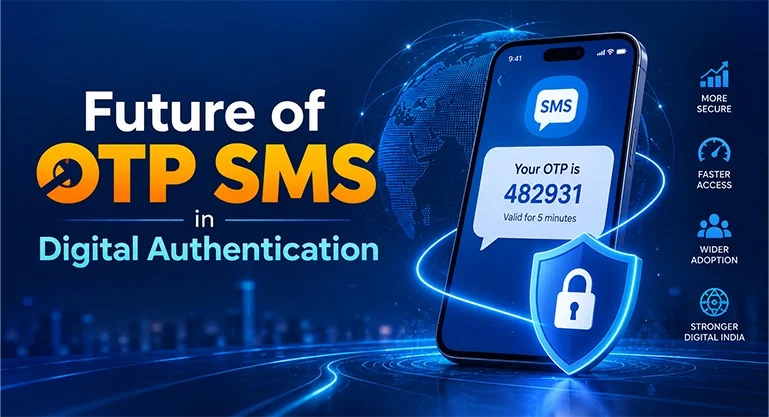
The Future of OTP SMS in Digital Authentication
The future of OTP SMS is likely to involve stronger security controls, better delivery systems & closer integration with multi-factor authentication.
SMS OTP may increasingly become one component of a broader authentication framework rather than the only security layer.
1. Smarter OTP Delivery
Authentication systems need to deliver codes quickly and consistently. Delayed OTPs can lead to failed logins, abandoned transactions & repeated requests.
Modern SMS platforms can help businesses improve delivery through better routing, delivery monitoring, sender management & automated retry mechanisms.
TextSMS can support businesses that require reliable OTP communication as part of their customer verification process.
2. OTP With Multi-Factor Authentication
OTP SMS is becoming more useful when combined with other authentication factors.
For example, a business could require:
Password + SMS OTP
PIN + SMS OTP
Device verification + SMS OTP
Biometric verification + OTP
This creates additional security layers and makes unauthorized access more difficult.
3. Shorter OTP Validity Periods
Security systems are increasingly focused on reducing the time available for an OTP to be misused.
A short expiration period can limit exposure if a code is intercepted or disclosed. Businesses can also restrict the number of verification attempts and invalidate previous codes when a new OTP is generated.
4. Risk-Based Authentication
Future authentication systems are expected to assess the risk of a login or transaction before deciding how much verification is required.
A normal login from a recognized device may require fewer steps. A suspicious login from an unfamiliar location or device could trigger an additional OTP or authentication factor.
This approach can improve both security and user experience.
5. Better Protection Against OTP Fraud
SMS OTP is not completely immune to threats. SIM swapping, social engineering, phishing, malware & unauthorized access to messages can create security risks.
Businesses therefore need to combine OTP SMS with sensible security controls.
Important measures include:
- Rate limiting
- OTP expiration
- Maximum verification attempts
- Device and IP monitoring
- Suspicious-login detection
- Secure API integration
- Transaction monitoring
- Clear user alerts
The future of OTP authentication will depend as much on the surrounding security architecture as on the OTP itself.
Use Case 1: Banking and Financial Services
Banks and financial platforms frequently use OTPs to verify customers during sensitive activities.
An OTP may be required when a customer logs in from a new device, resets credentials, adds a beneficiary, or confirms a transaction.
For example, a banking application can generate a six-digit OTP after detecting a new device. The code is delivered to the customer's registered mobile number. Once successfully validated, the requested action can proceed.
In this environment, fast delivery and strict expiration are important because authentication delays can interrupt customer activity.
Use Case 2: E-Commerce and Online Services
E-commerce businesses can use OTP SMS during registration, login, checkout & account recovery.
Consider a customer purchasing from an online store. Instead of relying only on a password, the platform can verify the customer's mobile number using an OTP before completing a sensitive account action.
This can also reduce fake registrations and help businesses maintain cleaner customer records.
Case Study 1: OTP Verification for an Online Marketplace
Illustrative case study
An online marketplace was receiving a large number of account registrations. Some users were creating multiple accounts, while others were entering incorrect mobile numbers.
The business introduced SMS OTP verification during registration.
The authentication flow was redesigned to generate a temporary code, deliver it through an SMS gateway & activate the account only after successful verification.
The result was a cleaner registration process, improved mobile-number validation & fewer incomplete or inaccurate registrations.
The key lesson was simple. OTP SMS worked best when it was integrated directly into the registration journey rather than treated as a separate verification step.
Case Study 2: OTP Authentication for a SaaS Platform
Illustrative case study
A SaaS company wanted to provide additional protection for accounts accessed from unfamiliar devices.
The company introduced SMS OTP as an additional verification step when its system detected a new device or unusual login activity.
Users could enter their normal credentials first. When the system identified a higher-risk login, an OTP was sent to the registered mobile number.
This approach allowed the business to add another layer of authentication without forcing every customer to install an authentication application.
The case demonstrates how OTP SMS can work effectively as part of risk-based and multi-factor authentication.
Challenges Facing OTP SMS
Although OTP SMS remains useful, businesses need to understand its limitations.
SMS depends on mobile network availability and can be affected by delivery delays. Users may also face problems when travelling, changing SIM cards, or using devices with poor network coverage.
Security is another concern. Phishing attacks can trick users into revealing OTPs, while SIM-swap attacks can create additional risks.
For this reason, businesses should avoid treating SMS OTP as an isolated security solution.
How Businesses Can Prepare for the Future
Companies planning to use OTP SMS should build authentication systems with security and reliability in mind.
Key practices include:
- Use a trusted SMS provider.
- Keep OTP validity periods short.
- Limit failed verification attempts.
- Monitor delivery and authentication events.
- Apply rate limits to OTP requests.
- Protect OTP APIs and credentials.
- Detect unusual login behaviour.
- Use additional authentication factors for sensitive actions.
- Provide users with clear security notifications.
A reliable SMS infrastructure can make a significant difference to the overall authentication experience.
Role of TextSMS in OTP Authentication
TextSMS can be used by businesses that need SMS-based communication for OTP verification and other transactional messaging requirements.
An OTP system requires more than simply sending a text message. Businesses need an authentication workflow that connects the application, OTP generation system, SMS gateway, delivery process & verification logic.
With the right infrastructure, businesses can create faster and more dependable verification journeys for their customers.
OTP SMS and the Rise of Passkeys
Passkeys and biometric authentication are gaining attention as alternatives to traditional passwords and some existing authentication methods.
However, the adoption of newer technologies will take time across different customer groups and industries.
OTP SMS can continue to serve as a practical verification method, particularly for account recovery, mobile-number verification, fallback authentication & users who do not have access to newer authentication mechanisms.
The future is therefore likely to involve several authentication methods working together.
FAQs
Yes. OTP SMS remains widely useful for mobile verification, account recovery, login security & transaction authentication. Its role is increasingly shifting toward being one part of a broader authentication strategy.
No authentication method is completely risk-free. SMS OTP can face risks such as phishing and SIM swapping. Businesses should combine OTP with rate limits, short expiry periods, monitoring & additional authentication controls where appropriate.
The appropriate validity period depends on the application's security requirements. A short validity period is generally preferred because it reduces the time available for an unused OTP to be misused.
Yes. Businesses can use OTP SMS to verify customers during sensitive transactions, provided the authentication process is designed with appropriate security controls.
It is unlikely that every use case will move to a single authentication method. Passkeys can provide strong passwordless authentication, while OTP SMS can remain useful for mobile verification, recovery, fallback access & other workflows.